
-
PRODUCTS
Biomass Screw Conveyor Carbonizer (Inner Indirect Heating)
Biomass Rotary Kilns Carbonizer (Inner Indirect Heating)
Biomass Rotary Kilns Carbonizer Torrefaction (Inner Indirect Heating)
- NET-ZERO
- TECHNOLOGY
- PROJECT
- COMPANY
- CONTACT US
- POWERMAX-GROUP

.webp?x-oss-process=image/resize,w_800/quality,q_100)
.webp?x-oss-process=image/resize,w_800/quality,q_100)
.webp?x-oss-process=image/resize,w_800/quality,q_100)
.webp?x-oss-process=image/resize,w_800/quality,q_100)
English
Modular Biochar Production Systems | Lower Carbon Removal Cost
Dec 30, 2025
Modular Biochar Production Systems | Lower Carbon Removal Cost
Executive Summary
Meeting global net-zero targets requires the rapid deployment of economically viable carbon dioxide removal (CDR) technologies. Pyrolysis-derived biochar offers a proven, durable carbon sequestration pathway, yet widespread adoption hinges on reducing biochar production cost while ensuring long-term stability.
| This article demonstrates how Pyrogreen's modular screw conveyor, rotary kiln, and fixed-bed pyrolysis systems can efficiently convert diverse biomass residues into high-stability biochar with superior agronomic and environmental benefits. Our modular design enables co-location with feedstock sources, drastically reducing logistics costs and providing a replicable. |

1. From Scientific Consensus to Engineered Reality
The carbon removal potential of biochar is firmly established in IPCC assessments and national net-zero roadmaps. The process thermally converts unstable organic carbon in biomass into highly aromatic, stable structures that can persist in soils for centuries.
As highlighted in recent research published in Biofuel Research Journal, "Among the three biomass-derived chars, biochar stands out as the most viable option for soil amendment due to its high stability, nutrient retention capacity, and long-term carbon sequestration benefits" (Mohammadi et al., 2025). Furthermore, biochar has successfully transitioned "from an experimental soil amendment to a commercially available product with increasing adoption in agriculture worldwide."
However, turning this scientific potential into a profitable business requires addressing key biochar production cost challenges. Early techno-economic studies showed traditional pyrolysis systems were often too expensive for widespread adoption. Pyrogreen's innovation lies in reactor design, thermal integration, and modular engineering—systematically lowering the production threshold to make biochar carbon credits an economically viable commodity within a market projected to grow from USD 680.84 million (2023) to over USD 2.1 billion by 2032, according to Fortune Business Insights market analysis.
2. Technology Core: Engineered for Performance & Profitability
Unmatched Performance & Reliability
|
||
| 8,000+ | ≥90% | 30% |
| Annual Runtime Hours Industry-leading operational reliability and uptime |
Fixed Carbon Content Premium quality biochar for optimal carbon sequestration |
Biochar Yield Efficient conversion of biomass to valuable biochar |
| Modular Design | Eco-Friendly | High Reliability |
| Scalable solutions that grow with your business needs, from small farms to industrial operations | Minimal emissions and energy-efficient operation for truly sustainable production | Engineered for continuous operation with minimal maintenance requirements |
|
High carbon sequestration value and agricultural efficacy demand biochar that meets stringent quality standards while being produced at a competitive biochar machine price. Standards like the European Biochar Certificate (EBC) use key indicators that our systems are designed to exceed. |
Pyrogreen systems ensure compliance and optimize for performance through precise engineering controls that directly impact your ROI on biochar investments:
Precise Temperature Control
|
Uniform Heat Distribution
|
Energy Self-Sufficiency
|
|
Optimal exposure in the 500–750°C range promotes aromatic cluster growth, yielding biochar with exceptional stability for long-term carbon sequestration and soil improvement. |
Screw conveyor and rotary kiln designs ensure consistent heating, preventing quality variations that can affect both carbon credit eligibility and soil amendment effectiveness. |
Captured syngas provides 60-80% of process energy, significantly reducing operational costs and improving the overall biochar business model economics. |
System Specifications & Applications
| System Type | Optimal Temperature | Target H/C Ratio | Best For | ROI Focus |
| Screw Conveyor | 450–650°C | <0.5 | High porosity for water retention | Premium soil amendment markets |
| Rotary Kiln |
500–700°C | <0.4 | Maximum carbon stability | Carbon credit optimization |
| Fixed-Bed System |
550–750°C | <0.6 | Cost-effective volume production | Large-scale agricultural use |
| Screw Conveyor Carbonization/ Torrefaction System |
Rotary Kilns Carbonization/ Torrefaction System |
Rotary Kiln Carbonization System (Inner Indirect Heating) |
Screw Conveyor CarbonizationSystem (Direct Heating) |
 |
 |
 |
 |
Beyond carbon metrics, our biochar's porous architecture acts as a superior substrate for nutrient retention and microbial habitat. Independent studies referenced in the Global Biochar Market Report show biochar application can reduce N₂O emissions by 18% on average and significantly mitigate nutrient runoff, providing clear environmental advantages that enhance both farm productivity and carbon credit project value.
3. Carbon Accounting & Business Economics
|
Understanding the financial model is crucial for any biochar business. Each tonne of high-quality biochar represents not just a soil improver, but a verified carbon removal asset with multiple revenue streams. |
Carbon Calculation
|
Revenue Streams
|
|
1 tonne biomass → 0.3-0.5 tonnes biochar → 2.5+ tonnes CO₂eq removed → 2.0+ tonnes net carbon credits after energy deduction |
1. Carbon credits (current avg: $176/tonne) 2. Biochar sales (soil amendment) 3. Waste disposal fees (if applicable) 4. Increased crop yields |
Certified Quality & Compliance
CE Certified Biomass Pyrolysis Systems |
||
|
Verification Number: TD63632501 Valid: December 4, 2025 - December 3, 2030 Standards: EN ISO 12100:2010, EN IEC 61000-6-2:2019, EN IEC 61000-6-4:2019 |
||
|
Compliant with Machinery Directive 2006/42/EC, Low Voltage Directive 2014/35/EU, and EMC Directive 2014/30/EU Our systems meet the highest European standards for safety, quality, and electromagnetic compatibility. |
||
|
Operational Safety Comprehensive safety features and compliance standards |
Quality Assurance Consistent production of high-quality biochar |
Market Access Global recognition for carbon credit programs |
Our modular approach directly targets the biggest barriers to biochar plant cost efficiency:
Reduced CAPEX: Modular design lowers initial investment by 20-30% compared to custom-built plants
Lower OPEX: Energy self-sufficiency cuts fuel costs significantly
Logistics Advantage: Co-location with feedstock eliminates expensive transport of bulky biomass
Sensitivity analysis shows that with optimal feedstock logistics and potential waste disposal fees, the levelized cost of carbon removal can reach £60–90/tCO₂eq. This positions Pyrogreen systems as not just environmentally sound, but financially compelling investments in today's growing carbon markets.
4. The Modular Advantage: Distributed Deployment
The true potential for carbon removal lies in distributed agricultural and forestry residues worldwide. Traditional centralized plants struggle with collection radius limitations and high logistics costs that hurt biochar production cost competitiveness.
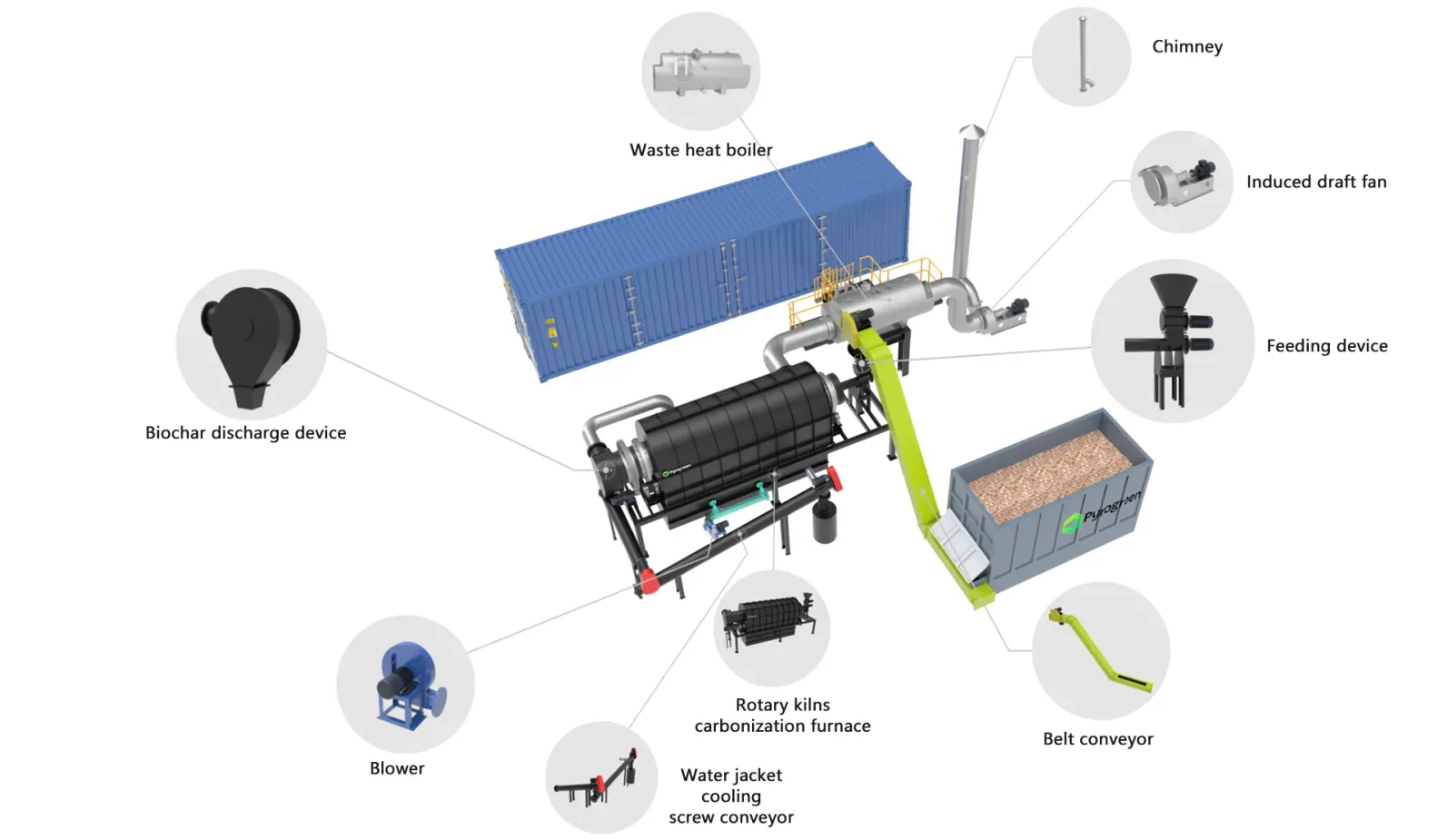
Pyrogreen's modular systems transform this challenge into an opportunity:
|
Rapid Deployment |
Flexible Scaling |
Local Optimization |
|
Pre-engineered modules install in weeks, not months, accelerating your biochar business timeline and ROI realization. |
Start small and expand as your feedstock supply and market demand grow, minimizing initial biochar machine price risk. |
Deploy directly at farms, sawmills, or processing sites to create a biomass waste solution that generates local value. |
This distributed model directly addresses the "economic and logistical constraints, including high production costs and transportation inefficiencies" that research identifies as current adoption barriers. By turning transportation cost centers into eliminated expenses, we make biochar carbon credits economically viable at scales previously unimaginable.
Ready to Transform Biomass into Value? |
| Join the growing number of farmers, project developers, and sustainability leaders who are turning waste into profit while removing carbon from the atmosphere. |
5. Beyond Carbon: Multiple Revenue Streams
High-stability biochar from Pyrogreen systems creates value beyond just carbon removal cost savings:
Soil Health Premium
|
Pollution Control
|
Circular Economy
|
|
Improves water retention (up to 45% in sandy soils) and nutrient holding capacity, potentially reducing fertilizer cost by 10-30%. |
Adsorbs heavy metals and excess nutrients, reducing water treatment costs and creating cleaner agricultural waste disposal solutions. |
Transforms liability (waste disposal) into asset (saleable products), creating a true turn waste into profit business model. |
Frequently Asked Questions
What is the typical biochar production cost with your systems?
Total production costs typically range from £60-90 per tonne of CO₂eq removed, depending on feedstock type, local energy costs, and scale. This includes a competitive biochar machine price with rapid ROI through carbon credits and product sales.
What ROI can I expect from a biochar project?
Most projects achieve ROI within 2-4 years through combined revenue from carbon credits, biochar sales as soil amendment, and potential waste disposal fees. The exact ROI of biochar depends on your feedstock costs and local market conditions.
What biomass materials work best?
Our systems process diverse materials: agricultural residues (straw, husks), forestry waste, food processing byproducts, and dedicated energy crops. This flexibility makes our technology an ideal biomass waste solution for various industries.
How do I sell the carbon credits?
We provide full support for carbon credit certification under major protocols (EBC, Puro.earth, Verra). Our biochar meets all stability requirements for high-quality carbon credit projects, and we can connect you with carbon market partners.
References & Citations
|
1.Mohammadi, P., Dang, C.H., Román, S., et al. (2025). Can biomass-derived chars serve as a viable alternative to commercial inorganic fertilizers? Biofuel Research Journal, 45, 2350-2372. |
|
2.European Biochar Foundation (EBC). (2024). Guidelines for a Sustainable Production of Biochar. European Biochar Certificate. |
|
3.International Biochar Initiative (IBI) & US Biochar Initiative (USBI). (2023). Global Biochar Market Report 2023. |
|
4.Fortune Business Insights. (2024). Biochar Market Size, Share & Industry Analysis, 2024-2032. |
6. Conclusion: Engineering a Carbon-Negative Future
Scalable biochar production has moved beyond technical demonstration into carbon credit-driven commercialization. Pyrogreen's modular pyrolysis systems represent the engineering evolution needed to make this transition economically viable at global scales.
By optimizing thermochemical conversion for high-stability outputs that meet stringent certification standards while solving feedstock logistics through distributed deployment, we provide more than equipment, we provide a complete biochar business model solution.
As carbon markets mature and agricultural sustainability becomes increasingly valued, projects leveraging our advanced, cost-optimized engineering will lead the transition to circular bioeconomies. The result is a tangible, multi-benefit pathway that truly enables you to "Save the Earth, Start with Carbon Removal".
Biochar application in agriculture showing improved soil health and plant growth
The future of sustainable agriculture and carbon removal: high-quality biochar improving soil health while generating carbon credits
CONTACT US
Contact US
Product Information
Quantity
Unit
Piece
Support order samples, customization, wholesale direct, and complete payment. If the product you look for does not have corresponding customized content, pls fill out the form below to contact us, and we will reply ASAP.